# Chapter 7: White Balance
Digital cameras require a certain amount of **calibration** to **capture color information (RGB) properly**. This calibration is called **white balance**, because the camera is being given the information it needs to identify white areas of the image and reproduce them correctly.
The image below shows the same scene white balanced to different color temperatures:
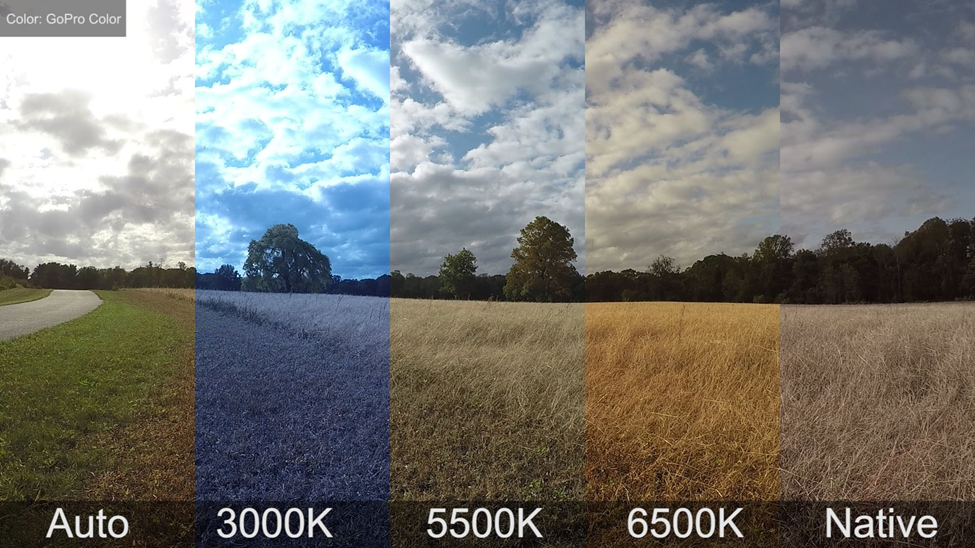
You can (and should) confirm or set the white balance on the Canon EOS 5D MkIV camera before capturing images or video. You can do this by pressing the **WB** button on the top right of the camera chassis. A menu will appear (it looks slightly different depending on whether you are shooting in image or video mode), and you can use the large dial on the right side of the camera chassis to select the white balance mode. The available **white balance options are**:
- **AWB** (auto white balance): the camera will seek an appropriate white balance for the **current lighting conditions**
- **Daylight**: the camera will set an appropriate white balance for **sunny daylight conditions**
- **Shade**: the camera will set an appropriate white balance for **shady daylight conditions**
- **Cloudy**: the camera will set an appropriate white balance for **cloudy/overcast conditions**
- **Tungsten Light**: the camera will set an appropriate white balance for **tungsten light** (~3200K, a warm, orange light)
- **Fluorescent Light**: the camera will set an appropriate white balance for **fluorescent light**, such as in an office building
- **Flash**: the camera will set an appropriate white balance for the **color temperature of the camera's built-in flash**
- **Custom**: you can **take a photo** of a white surface **under desired light conditions** and then **use it to set the white balance**
- **Color Temperature**: you can manually set the white balance to be appropriate for **different color temperatures**
Which setting should you use? It will depend on what you are trying to accomplish, but the most usual settings would be:
- **AWB** if you do not want to control the white balance for yourself
- **Daylight**, **shade**, or **cloudy** if you are shooting outdoors under **natural light**
- **Color temperature** if you are shooting in the studio and know the color temperature of your lighting conditions
You should check and confirm your white balance setting **before** you begin a photo or video shoot. Typically, you will want to leave the white balance setting alone once you set it to your preferred selection.